Why Certain Hotels Attract Tragedy
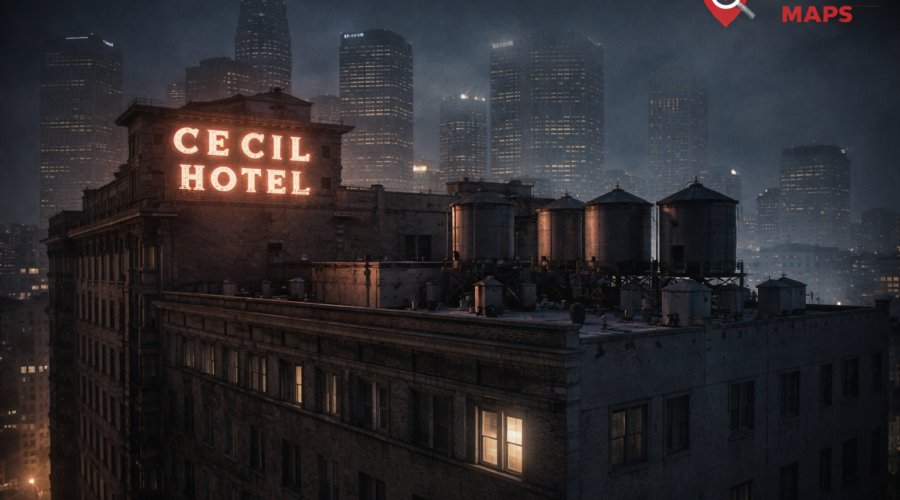
The Cecil Hotel
Hotel Congress
The Drake Hotel


Introduction: It’s Not the Building — It’s the System Around It
When a hotel becomes associated with crime, the narrative usually leans toward something supernatural, cursed, or darkly mysterious.
But in most cases, the explanation is less paranormal — and more structural.
Certain hotels don’t “attract” tragedy because of evil energy.
They become vulnerable because of:
- Location
- Economic shifts
- Building design
- Social anonymity
- Policing gaps
- Long-term tenancy patterns
When you look at crimes through a geographic lens — the way we do at True Crime Maps — patterns begin to emerge.
And those patterns are rarely random.
1. Location Matters More Than Legend
Many infamous hotels sit in transitional urban zones — areas between business districts and economically distressed neighborhoods.
Take The Cecil Hotel in downtown Los Angeles.
It sits in an area historically known as Skid Row — a neighborhood marked by:
- High transient populations
- Substance abuse crises
- Economic instability
- Overburdened public services
Hotels in these zones often become hybrid spaces:
- Budget tourism
- Long-term residential housing
- Emergency shelter overflow
- Transitional living
This mixture creates instability.
Not because of the building — but because of density + vulnerability + anonymity.
2. High Transience = Low Accountability
Hotels differ from apartments in one crucial way:
People come and go constantly.
In long-term housing:
- Neighbors recognize each other
- Unusual activity stands out
- Social accountability exists
In high-transience hotels:
- Guests rotate weekly
- Staff turnover is high
- Hallway encounters are anonymous
- Unusual behavior blends in
This creates what criminologists call “low guardianship.”
When people don’t know each other, suspicious behavior often goes unchallenged.
This is not a moral failure.
It’s a structural one.
3. Architecture Can Create Blind Spots
Older hotels, especially those built in the early 1900s, often have:
- Multiple stairwells
- Service corridors
- Rooftop access
- Long narrow hallways
- Poor lighting
- Limited camera coverage (especially pre-2010)
These features were not built with modern surveillance in mind.
Compare that to newer boutique hotels:
- Open lobby concepts
- Visible staff desks
- Digital key tracking
- Integrated CCTV systems
Design impacts safety.
In older buildings, especially those retrofitted into low-budget housing, blind spots multiply.
4. Economic Decline Changes Building Function
Many historic hotels were once luxury destinations.
Over time, as cities expanded and wealth shifted outward, some downtown hotels experienced:
- Reduced tourism
- Lower nightly rates
- Conversion to single-room occupancy (SRO)
- Long-term residential leasing
When this happens, the building’s purpose changes — but its infrastructure doesn’t always adapt.
Hotels like Hotel Congress and The Drake Hotel have survived by modernizing while maintaining historic appeal.
Others struggled during economic downturns and became safety nets for populations facing instability.
Again — not cursed.
Contextual.
5. Tourism Density + Urban Pressure
Hotels in dense downtown cores face another factor:
They are located near:
- Transit hubs
- Bars and nightlife
- Major intersections
- Large homeless populations
- High pedestrian volume
That means:
More strangers.
More late-night activity.
More opportunity for crime.
Routine Activity Theory — a foundational criminology concept — explains that crime occurs when:
- A motivated offender
- A suitable target
- Lack of capable guardianship
…intersect in space and time.
Hotels can become the literal intersection of those three elements.
6. Media Amplification Turns One Incident Into Identity
One tragedy can permanently alter public perception.
The media narrative solidifies:
“This hotel is dangerous.”
Even if statistically, incidents are rare relative to occupancy.
The psychological impact outlives the data.
And once a building gains a reputation:
- Online speculation grows
- Urban legends form
- Paranormal narratives attach
- YouTube videos amplify mythology
The building becomes symbolic.
But symbolism isn’t evidence.
7. The Myth of “Cursed Places”
There is no credible evidence that certain buildings are inherently “evil.”
What exists instead:
- Economic pressure
- Urban density
- Transitional neighborhoods
- Design limitations
- High anonymity
- Mental health crises
- Substance abuse epidemics
When these stack together geographically, incidents rise.
Mapping these layers reveals more than storytelling ever could.
8. What Mapping Reveals
When you zoom out on crime maps across major U.S. cities, you’ll notice:
- Crime clusters near transit corridors
- High-density housing overlaps with higher incident rates
- Economic distress zones correlate with violence
- Tourist-heavy districts show spikes in certain crimes
Hotels are often placed precisely where these zones overlap.
The building isn’t the cause.
It’s the crossroads.
9. The Responsibility of True Crime Coverage
It’s easy to sensationalize.
It’s harder — and more important — to contextualize.
At True Crime Maps, the goal is not to label locations as cursed.
It’s to understand:
- Environmental risk factors
- Structural vulnerabilities
- Urban patterns
- How geography influences behavior
Because when we understand the system, we reduce myth.
And when we reduce myth, we improve prevention.
Conclusion: Patterns Over Paranormal
Certain hotels don’t attract tragedy because of dark energy.
They sit at intersections of:
- Anonymity
- Economic strain
- Architectural blind spots
- Social instability
- High mobility populations
The building is the stage.
The city writes the script.
And geography connects the dots.

